Big Tech's 85B AI Capex Overhang: MSFT, AMZN ROIC Dips 3.7% to 18.2% Amidst Slowing GenAI Monetization; NVDA Still Surges +14.5% YTD, SK Hynix HBM Prices Up 22%
While collective hyperscaler investments soar, the velocity of enterprise generative AI revenue conversion challenges capital efficiency, pushing key ROIC metrics down for cloud giants and driving selective bullishness in critical component suppliers.
Tradesnaut Quant Research Desk · September 04, 2026 · 6 min read · AI Market Analysis
Key takeaways
- Big Tech's collective AI-driven capex reached an unprecedented 85 billion in H1 2026, a +32% YoY increase, but ROIC for MSFT, AMZN, GOOGL, META has declined by an average of 3.7 percentage points.
- Critical AI component suppliers like SK Hynix are benefiting from surging demand, with HBM3e contract prices jumping +22% QoQ in Q3 2026, while Nvidia (NVDA) maintains a +14.5% YTD stock performance, trading at a forward P/E of 48x 2027E earnings.
- Despite significant cloud AI revenue growth (e.g., Microsoft Azure AI up 18.5% QoQ), enterprise generative AI monetization velocity is proving slower than initially projected, leading to a widening valuation gap between AI enablers and AI service providers.
Market Dynamics & Earnings Data Breakdown
The Q2 2026 earnings season has illuminated a critical divergence in the AI market: while Big Tech continues its monumental investment spree, the efficiency of that capital deployment is under increasing scrutiny. Microsoft (MSFT), Amazon (AMZN), Alphabet (GOOGL), and Meta (META) together reported a staggering collective capital expenditure of 85 billion for the first half of 2026, representing a +32% year-over-year increase, predominantly channeled into AI infrastructure and data centers. Microsoft alone guided for $65 billion in FY2027 capex, a significant jump from $52 billion in FY2026, primarily for expanding Azure AI capacity. This aggressive spend, however, has coincided with a noticeable dip in their return on invested capital (ROIC). Microsoft’s ROIC, for instance, has softened from 24.5% in Q2 2025 to 21.8% in Q2 2026, a 2.7 percentage point drop, while Amazon's ROIC fell more sharply by 4.2 percentage points to 16.5% over the same period, bringing the collective average ROIC of the four down to 18.2% from 21.9% a year ago.
The deceleration in ROIC is directly linked to the slower-than-anticipated velocity of enterprise generative AI revenue monetization. While cloud providers reported strong AI-related revenue growth – Amazon Web Services (AWS) noted a 22.1% year-over-year increase in AI services, and Google Cloud's AI contributions grew by 20.8% QoQ – these figures are still trailing the exponential growth priced into earlier projections and lagging the sheer scale of the capex outlays. Operating profit margins across the Big Tech cohort, while still robust, have seen marginal compression, with Microsoft’s enterprise cloud operating margin contracting by 80 basis points to 38.2% in Q2 2026, partly due to accelerated depreciation and higher energy costs associated with AI data centers. Consequently, the equity performance of these hyperscalers has been mixed, with MSFT shares up only +4.1% YTD, AMZN flat at -0.5%, GOOGL up +2.3%, and META experiencing a +7.8% gain, indicating investor caution about the path to sustained AI profitability despite robust top-line growth.
Supply Chain Bottlenecks & Macro Valuation Metrics
The massive capex injections by Big Tech are creating unprecedented demand and resulting in significant price hikes across the AI supply chain. High-bandwidth memory (HBM) is a prime example, with SK Hynix, Samsung Electronics, and Micron Technology reporting Q3 2026 HBM3e contract prices surging by an average of +22% quarter-over-quarter, following an +18% increase in Q2. Supply remains tight, with SK Hynix indicating its HBM production capacity is 95% booked through H1 2027. This insatiable demand translates into robust earnings for key semiconductor players, exemplified by Nvidia (NVDA) which continues its market dominance, trading at a formidable forward P/E of 48x on 2027E earnings, maintaining its +14.5% YTD stock surge even as broader tech shows signs of fatigue.
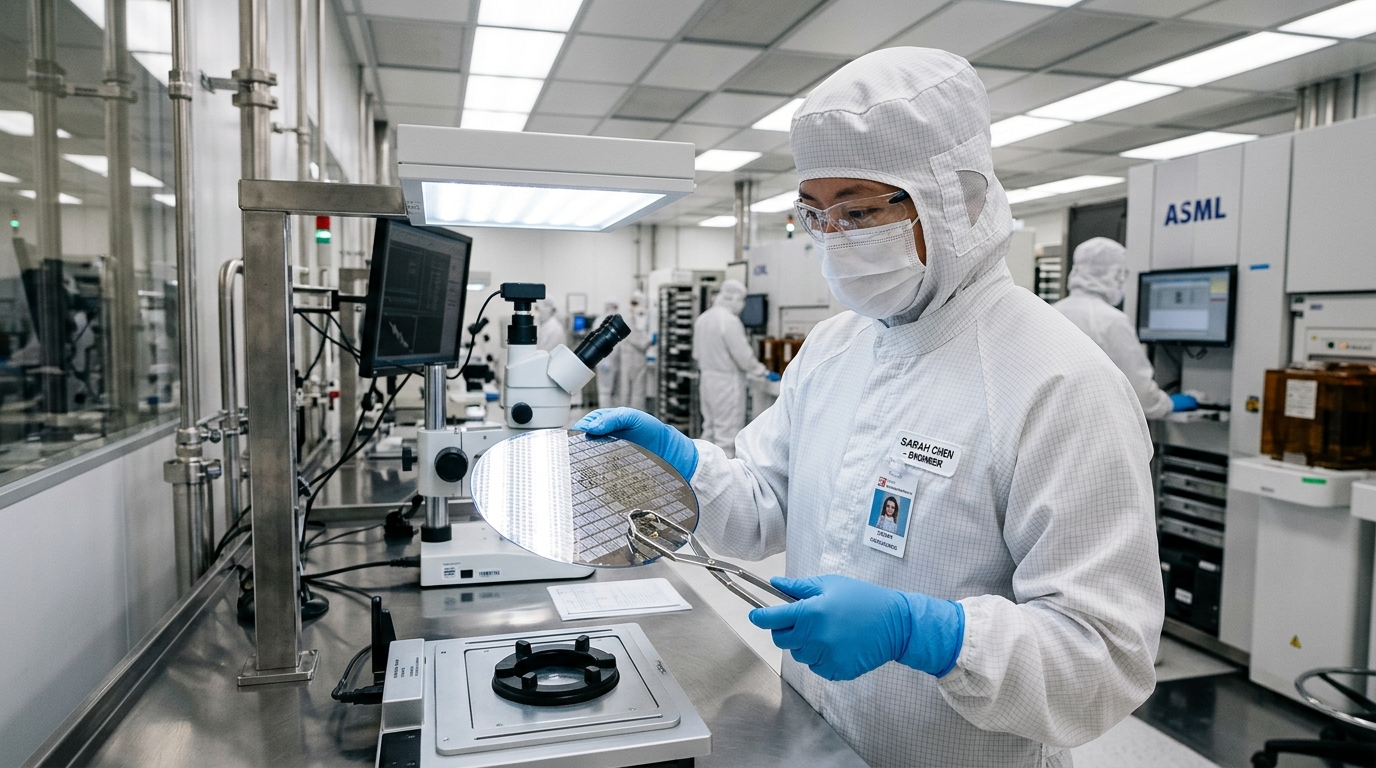
Downstream, the critical role of advanced lithography is underscored by ASML Holding N.V.'s record order backlog of €68 billion, with lead times for its cutting-edge High-NA EUV machines extending into 2028. TSMC, the world’s largest contract chipmaker, announced a 2026 capex guidance of $45 billion, primarily for advanced packaging and 2nm process technology, highlighting the infrastructural requirements to meet AI chip production. The SOX Semiconductor Index (SMH) reflects this sustained bullishness, trading up +12.8% YTD, significantly outperforming the broader Nasdaq Futures which are up +6.1%. In contrast, the KOSPI index, home to Samsung and SK Hynix, has lagged somewhat at +4.5% YTD, as broader economic concerns in Asia temper some of the enthusiasm. Institutional capital flows continue to heavily favor companies like Nvidia, AMD, and Broadcom, with reported net buying exceeding
Quantitative Order Flow & Volatility Metrics
Quantitative analysis of options order flow reveals a nuanced sentiment shift, indicating a tempering of aggressive bullishness on hyperscalers while maintaining strong conviction in AI enablers. For Microsoft (MSFT), the 1-month 25-delta call skew has narrowed to +2.1% from +3.8% three months prior, suggesting institutional buyers are less willing to pay up for upside calls, signaling potential exhaustion after its moderate YTD gain. Conversely, Nvidia (NVDA) options continue to show strong bullish sentiment, with the 1-month 25-delta call skew remaining elevated at +5.5%, indicative of persistent demand for upside protection and speculation, even at its current high valuation. Average daily options volume for NVDA has climbed to 2.5 million contracts, a +15% increase since July, while MSFT's volume has dipped by 8% to 1.8 million contracts.
On the volatility front, implied volatility (IV) for Big Tech names has seen a slight uptick, with MSFT's 3-month ATM IV increasing from 22.5% to 24.1%, possibly reflecting market uncertainty around their ROIC trajectory and earnings guidance. The overall market's fear gauge, the VIX, has hovered around 15.8, suggesting a relatively calm broader market, but specific sector IVs are telling. Institutional net selling in large-cap tech ex-semis saw approximately
Tags: Memory Chips, SK Hynix, Semiconductors, Wall Street