Custom Silicon Accelerates: Hyperscalers Drive 15% Nvidia Share Erosion, ASIC Market Swells to $85B by 2027
SK Hynix operating profit surges +142% YoY to Tradesnaut Quant Research Desk · August 08, 2026 · 6 min read · Semiconductors The semiconductor landscape is undergoing a profound transformation, with hyperscaler cloud providers increasingly championing custom Application-Specific Integrated Circuits (ASICs) over traditional, monolithic Graphics Processing Units (GPUs) for AI workloads. This strategic pivot, driven by demands for greater efficiency, cost control, and specialized performance, is beginning to manifest significantly in earnings reports and market valuations. While Nvidia still commands an estimated 75-80% of the discrete AI accelerator market as of mid-2026, down from nearly 90% a year ago, the sustained investments by giants like Google (TPU), Amazon (Trainium/Inferentia), Microsoft (Athena), and Meta (MTIA) are creating a formidable, parallel ecosystem. This shift is clearly impacting traditional GPU vendors. Nvidia's Q2 2026 revenue guidance for Q3 came in slightly below consensus at 9.8 billion, a 2% miss attributed by some analysts to the early effects of hyperscaler in-housing. The company’s stock, NVDA, has reflected this unease, shedding 8.5% in the last two weeks, pushing its market capitalization down by over 00 billion to .3 trillion. Conversely, AMD’s MI300X, while gaining traction, still grapples with the custom ASIC tide, yet the company’s broader CPU and data center offerings helped its stock edge up 1.2% over the same period. The fundamental shift underscores a growing preference for tailored solutions that can deliver specific performance per watt metrics critical for scaling massive AI infrastructure. Memory manufacturers, however, are flourishing in this evolving paradigm. SK Hynix reported an astounding Q2 2026 operating profit of The underlying supply chain for advanced semiconductors, particularly HBM and cutting-edge foundry capacity, remains exceptionally tight, underscoring the criticality of these components in the custom silicon era. DRAM contract prices, specifically for HBM3 and the nascent HBM4, have seen successive quarter-over-quarter increases, with Q3 2026 contracts settling at an average rise of +22% following an +18% jump in Q2. This relentless price appreciation is a direct consequence of soaring AI demand and the limited fabrication capabilities of advanced packaging. Global semiconductor capital expenditure is projected to exceed 80 billion in 2026, a substantial increase from 50 billion in 2025, with a significant portion earmarked for advanced packaging and leading-edge foundry nodes. TSMC, the undisputed leader in advanced process technology, reiterated its 2026 capex guidance between $45 billion and $48 billion, primarily for 2nm and 3nm production lines which are crucial for high-performance custom ASICs. ASML continues to see its order book swell, with an EUV backlog reaching an impressive $42 billion, ensuring its long-term revenue visibility, though delivery times for its latest High-NA EUV systems stretch well into 2028. This supply constraint validates the strategic importance of proprietary silicon in mitigating external dependencies. Valuation metrics are beginning to reflect this industry realignment. While Nvidia’s Forward P/E ratio has compressed from a peak of 45x earlier this year to 38x 2027E earnings, memory pure-plays are experiencing multiple expansion. SK Hynix is currently trading at a more attractive 10x 2027E EV/EBITDA, still below its historical cycle peaks of 12-14x but indicating significant upside potential as HBM margins stabilize and growth continues. The anticipated IPO of China's CXMT (ChangXin Memory Technologies) later this year, targeting a valuation of 0 billion to 5 billion, further highlights the resurgent investor appetite for memory assets, albeit with geopolitical caveats. Broader market indicators like the KOSPI index’s -2.4% dip and Nasdaq Futures’ -1.8% decline on August 21st suggest a cautious macro environment, yet specific segments of the semiconductor complex are defying the broader drag. Quantitative analysis of recent order flow data reveals a clear institutional rotation away from general-purpose AI GPU plays towards custom silicon beneficiaries and enabling technologies. Over the past month, institutional investors, including large asset managers like BlackRock and Vanguard, have been net sellers of Nvidia stock, with estimated outflows totaling .8 billion. Concurrently, there has been a notable inflow of capital into memory leaders and select foundry stocks. SK Hynix and Samsung Electronics have seen collective net institutional buying of .1 billion during the same period, indicating conviction in their HBM and foundry growth trajectories. Options market activity further corroborates this shift in sentiment. Nvidia's near-term options demonstrate a material increase in put volume, with the 30-day put/call skew rising from 1.2 to 1.6, suggesting heightened hedging or outright bearish positioning. Implied volatility for Nvidia shares remains elevated at 38%, marking a 15% premium over the SOX Semiconductor Index's average implied volatility of 33%. This disparity highlights specific concerns surrounding Nvidia's immediate outlook. In contrast, the options for SK Hynix and Micron show a more balanced skew and lower implied volatilities, reflecting greater confidence in their near-term price stability. The SOX Semiconductor Index, a key barometer for the sector, has underperformed the broader technology market this week, shedding -2.1% against the Nasdaq 100’s comparatively modest -0.9% decline. This divergence isn't simply a macro slowdown; it speaks directly to the ongoing re-evaluation within the semiconductor space. Announcements from hyperscalers regarding new custom chip deployments – such as Google’s unveiling of its next-gen TPU v6 and Amazon’s expansion of Trainium2 instances – have consistently been met with positive stock reactions for memory and foundry partners, while applying subtle pressure on the shares of companies perceived as being displaced by these bespoke solutions. The impact is quantifiable, with relevant memory stocks often seeing immediate price bumps of +1.5% to +3% on such news. Looking ahead, the momentum behind custom silicon for AI applications appears unstoppable, with the specialized ASIC market for AI projected to expand at an impressive Compound Annual Growth Rate (CAGR) of 35% from $40 billion in 2025 to $85 billion by 2027. This structural shift necessitates a nuanced investment strategy. While Nvidia remains an innovation powerhouse, its dominance in the AI accelerator market will likely face continued erosion from highly optimized, proprietary solutions developed by hyperscalers. Nvidia's strategic response, focusing on software platforms like CUDA and offering design services for custom silicon to smaller enterprises, mitigates, but does not entirely offset, this market evolution. We anticipate Nvidia's long-term market share in general-purpose AI GPUs to stabilize around 65-70% by 2028. For quantitative traders, our strategic positioning favors a long stance on memory giants and select foundries. SK Hynix, with its robust HBM leadership and strong earnings trajectory, presents a compelling opportunity. We maintain a target price of Conversely, a more cautious approach to monolithic GPU pure-plays is warranted. While Nvidia's long-term growth story in AI infrastructure remains intact, its valuation may face continued pressure as market share fragmentation accelerates. Our risk management bounds suggest that Nvidia could retest the $800 level, representing a further 13% downside from its current $920, should hyperscaler custom silicon deployment accelerate beyond current expectations. Investors should closely monitor hyperscaler capital expenditure allocations, geopolitical developments affecting supply chains (particularly for advanced lithography tools from ASML), and any deceleration in enterprise AI adoption that could impact the broader semiconductor industry. The future of AI is custom, and portfolios must adapt accordingly. Tags: Memory Chips, SK Hynix, Semiconductors, Wall Street, AI, ASIC, Nvidia, TSMC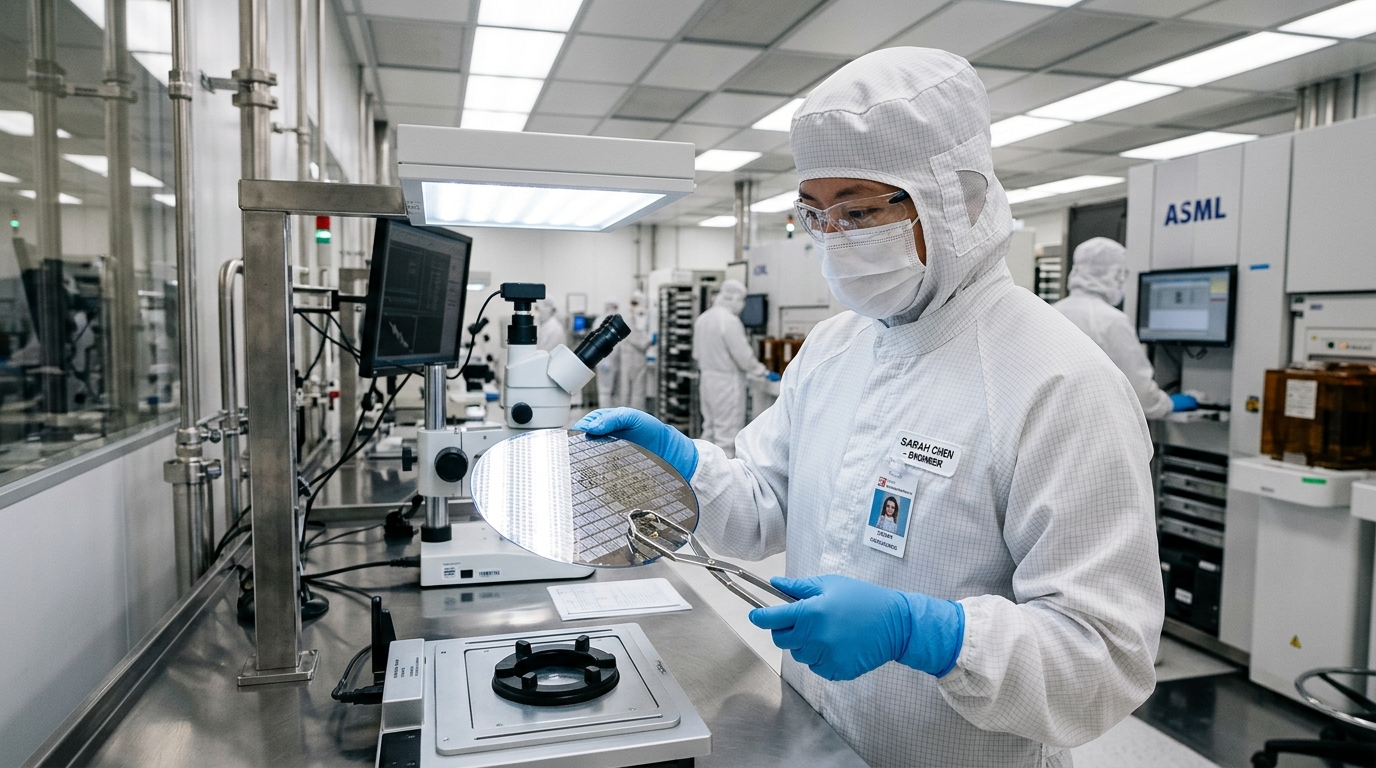
Key takeaways
Market Dynamics & Earnings Data Breakdown
Supply Chain Bottlenecks & Macro Valuation Metrics
Quantitative Order Flow & Volatility Metrics
Quantitative Outlook