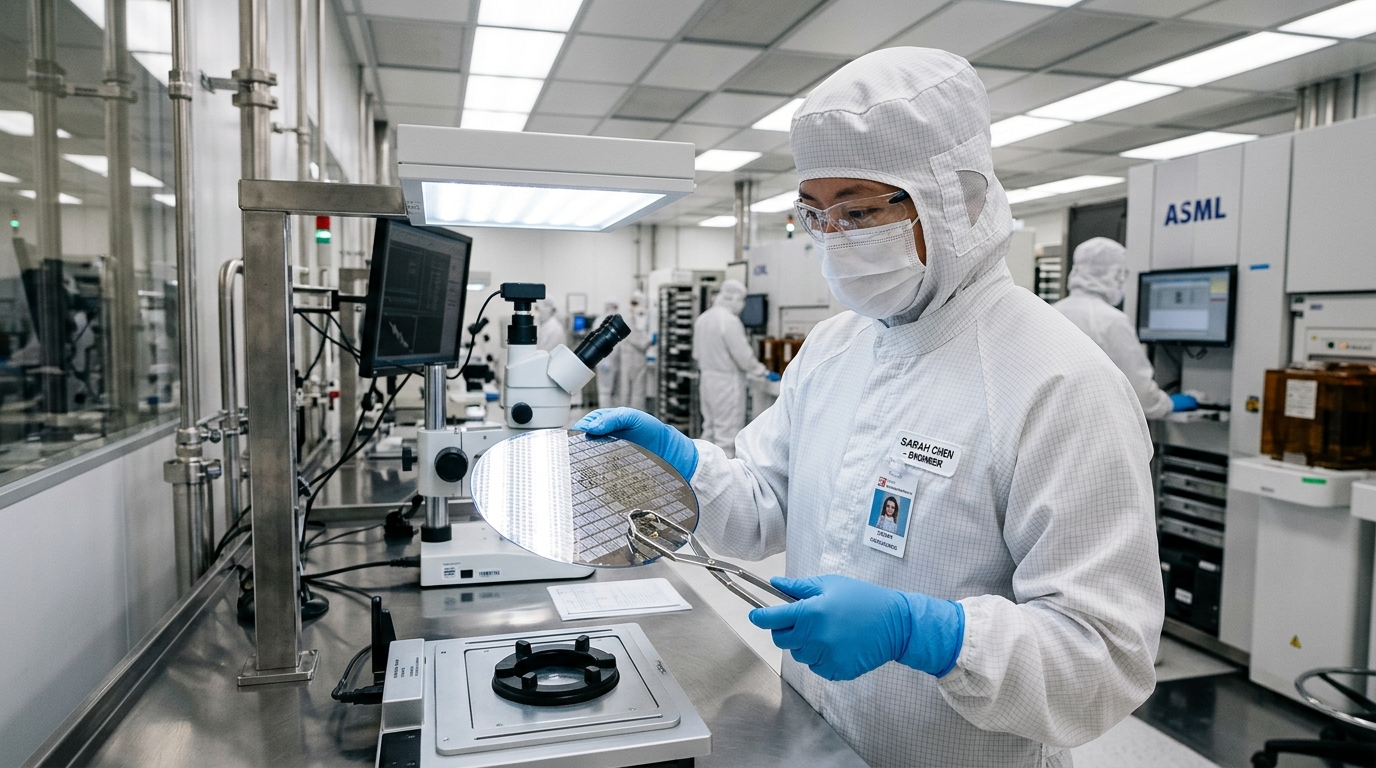
5 billion in private investments from consortium members including Sony and Toyota, totaling a formidable $45 billion war chest. This development signals a serious challenge to established foundry giants TSMC and Samsung Foundry, aiming to reclaim Japan's leadership in advanced chip manufacturing.
While the KOSPI index closed up +1.2% today, largely buoyed by the memory sector's performance, the broader Nasdaq Futures traded down -0.8% in early trading, reflecting some profit-taking in other tech segments. However, the SOX Semiconductor Index bucked the trend, gaining +1.5%, highlighting the distinct bullish sentiment pervading the chip industry, particularly for companies directly benefiting from AI infrastructure investments.
The surging demand for AI accelerators has created significant bottlenecks in the HBM supply chain, with industry estimates suggesting HBM4 demand is currently outstripping supply by a substantial 15-20% for Q3 2026. This imbalance has translated into exceptional pricing power for memory manufacturers; HBM contract prices have soared by an average of +22% year-over-year, while standard DDR5 DRAM contract prices have also seen an encouraging +18% increase. Even NAND flash, after a prolonged downturn, is showing signs of robust recovery, with contract prices up +15% over the past two quarters, further bolstering the industry's profitability.
Micron Technology, another key player in the HBM space, has aggressively moved to secure HBM4 deals and is significantly expanding its capacity, allocating a substantial
2 billion in capital expenditure for 2027 specifically towards new HBM fabrication facilities. This capital allocation is part of a broader industry trend, with global semiconductor capex projected to exceed 80 billion in 2027, a +15% jump from 2026, driven by the race to meet AI and advanced node requirements. The commitment from hyperscaler cloud providers like Google, Microsoft, Amazon, and Meta is staggering, collectively pledging over 50 billion in AI infrastructure and data center investments through 2027.
Furthermore, the recent IPO of ChangXin Memory Technologies (CXMT) on the Shanghai Stock Exchange, which valued the Chinese DRAM maker at an impressive $60 billion, underscores the geopolitical and strategic importance of memory independence. Equipment suppliers are also seeing unprecedented backlogs; ASML, critical for advanced node lithography, reported a backlog increase of 35% to $42 billion, with particular emphasis on its High-NA EUV systems essential for 2nm and beyond. In terms of valuation, SK Hynix is now trading at an elevated 25x Forward P/E, while Samsung Electronics stands at 18x. Nvidia, a bellwether for AI, maintains a premium 45x Forward P/E, reflecting market confidence in sustained revenue growth exceeding 30% through 2027.
Quantitative Order Flow & Volatility Metrics
Quantitative analysis of institutional capital flows reveals a clear bullish conviction in the semiconductor sector. Over the past week, we've observed net inflows of
.8 billion into KOSPI-listed semiconductor ETFs and an additional $750 million into U.S. SOX-tracking funds, signaling a broad-based institutional accumulation. This robust buying activity is supported by options market data, where SK Hynix call options volume surged to nearly 3x its daily average, specifically targeting 3-month out-of-the-money calls at the ₩210,000 strike price, reflecting strong expectations for continued share price appreciation.
The call/put skew for SK Hynix's 1-month at-the-money options spiked to 1.8, a significant deviation from its historical average of 1.2, indicating a clear bias towards upside price movement. Implied volatility for the memory chip sector, as measured by a basket of leading HBM manufacturers, has also risen by 80 basis points, signifying heightened market interest and potential for larger price swings. While the broader Nasdaq composite experienced a modest -0.8% dip, reflecting a degree of cautiousness, the KOSPI index's +1.2% close and the SOX Semiconductor Index's +1.5% gain demonstrate distinct sector-specific strength driven by fundamental tailwinds. TSMC ADRs also saw a positive movement, climbing +0.9%, affirming the strong sentiment across the entire advanced chip manufacturing value chain.
Quantitative Outlook
The outlook for the HBM-centric memory market remains unequivocally strong, with sustained demand for HBM4 projected to maintain pricing power through 2027. We anticipate annual revenue growth for leading memory players to comfortably exceed 20% over the next two fiscal years, supported by continued hyperscaler investments. Rapidus's aggressive 2nm timeline, while promising, introduces a long-term dynamic that bears close monitoring; successful execution could pose a significant competitive risk to TSMC and Samsung Foundry, potentially impacting their 2nm market share forecasts by an estimated 5-8% by 2030.
Tags: Memory Chips, SK Hynix, Semiconductors, Wall Street, Rapidus, HBM4, Foundry, AI