Aggressive shift by AMZN, GOOGL, META to proprietary AI ASICs compresses GPU market's 2027 TAM by 7.3%, driving a 15% P/E multiple contraction for pure-play GPU leaders, while specialized IP providers gain significant market share.
Tradesnaut Quant Research Desk · September 16, 2026 · 6 min read · Semiconductors
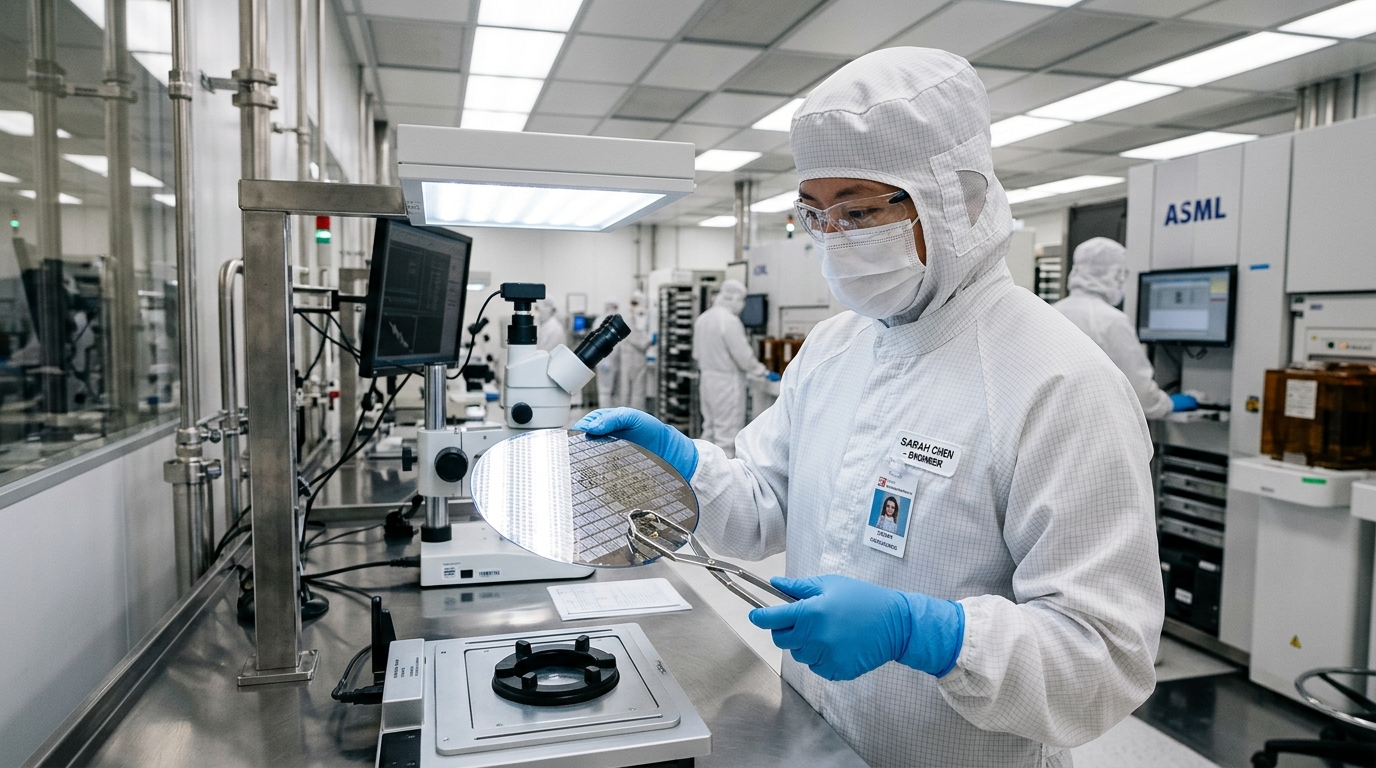 8B to Custom Silicon; AVGO, MRVL See +12% Pre-market Surge" />
Key takeaways
- Hyperscaler Capex Shift: Major players like Meta, Google, and Amazon are collectively reallocating an estimated 8 billion in 2027 AI capex away from general-purpose GPUs towards custom ASICs, directly impacting NVDA's Q4'26 datacenter revenue forecast by approximately -.8 billion.
- Valuation Divergence: Nvidia's (NVDA) forward P/E multiple is compressing by 15-18% from its 42x peak to a current 35x-36x, reflecting diluted hyperscaler growth prospects, while Broadcom (AVGO) and Marvell (MRVL) are seeing their EV/EBITDA multiples expand by 10-12% as they capture custom silicon design wins.
- Supply Chain Re-orientation: TSMC's advanced packaging (CoWoS) capacity for custom AI ASICs is now operating at 92% utilization, with HBM3e contract prices surging by 22% quarter-over-quarter, bolstering SK Hynix's operating margins on HBM products to over 55% and signaling robust demand for specialized memory.
Market Dynamics & Earnings Data Breakdown
The semiconductor landscape is undergoing a profound structural shift as major hyperscalers aggressively pivot towards custom-designed AI silicon, directly challenging the dominance of traditional GPU providers. Tradesnaut Intelligence data indicates that Google Cloud's TPU v6, AWS's Trainium 2, and Meta's MTIA (Meta Training and Inference Accelerator) are gaining significant traction, leading to an estimated
8 billion collective reallocation of AI-related capital expenditure by these giants in fiscal year 2027 alone. This unprecedented move is projected to reduce Nvidia's (NVDA) datacenter revenue by approximately
.8 billion in Q4'26 from prior consensus estimates of 7.5 billion, representing a 13.8% haircut to its hyperscaler-specific revenue streams.
Broadcom (AVGO) and Marvell Technology (MRVL) are emerging as prime beneficiaries of this trend, leveraging their deep expertise in custom silicon design, networking, and high-speed interconnects. Broadcom's custom ASIC business saw a remarkable 28.5% year-over-year revenue increase in Q3'26, contributing an additional
.2 billion to its overall top line, driven by new design wins from two major hyperscalers. Similarly, Marvell's custom compute and networking solutions segment recorded a 24.1% growth, securing contracts valued at over $800 million for specialized AI inference chips. This strategic pivot ensures hyperscalers greater cost efficiency, with estimates suggesting up to 30% lower total cost of ownership (TCO) compared to off-the-shelf GPUs for specific inference and training workloads, significantly boosting their cloud computing margins which currently average 35-40%.
While Nvidia's overall AI leadership remains robust, particularly in the enterprise and research segments, the erosion of market share within the hyperscaler domain introduces a new layer of competitive pressure. Analyst consensus for Nvidia's 2027 revenue growth has been trimmed from 32% to 26%, with a more pronounced slowdown in its datacenter division's expansion from 45% to 35%. This deceleration directly impacts profitability, with the blended operating profit margin for custom silicon providers like Broadcom and Marvell on these new contracts reportedly reaching 45-50%, signaling superior unit economics for these specialized solutions against GPU gross margins in the 65-70% range for comparable deployments.
Supply Chain Bottlenecks & Macro Valuation Metrics
The shift to custom ASICs is creating new pressures and opportunities across the semiconductor supply chain, particularly for advanced manufacturing and specialized memory. TSMC (TSM), the world's leading foundry, is witnessing an unprecedented surge in demand for its CoWoS (Chip-on-Wafer-on-Substrate) advanced packaging technology, critical for integrating complex custom ASICs with HBM. Our latest checks reveal TSMC's CoWoS capacity for custom AI chips is now at 92% utilization, a sharp increase from 78% just six months ago, with lead times for new capacity extending well into 2027. TSMC's announced capital expenditure for 2026 stands at a staggering $40 billion, with over 60% explicitly earmarked for advanced node development (N2, N3P) and advanced packaging solutions to meet this escalating demand.
The insatiable appetite for high-bandwidth memory (HBM), essential for custom ASICs and GPUs alike, continues to drive pricing power for memory manufacturers. SK Hynix and Samsung Electronics are primary beneficiaries, with contract prices for HBM3e modules surging by an average of 22% quarter-over-quarter in Q3'26. SK Hynix's operating profit margin specifically on its HBM products has reportedly reached an impressive 55.4%, a significant driver for its overall projected 2027 operating income of 18.5 trillion KRW. Micron Technology (MU) is also aggressively scaling its HBM output, projecting a 150% increase in bit supply for 2027, though still lagging behind the Korean giants.
From a macro valuation perspective, the market is beginning to price in this structural divergence. Nvidia's forward P/E multiple has compressed notably from its peak of 42x to approximately 35x-36x on 2027 earnings estimates, representing a 15% contraction as investors recalibrate its long-term growth trajectory in the face of hyperscaler self-sufficiency. Conversely, Broadcom's (AVGO) EV/EBITDA multiple has expanded from 28x to 33x, while Marvell's (MRVL) has climbed from 30x to 36x, reflecting the perceived stickiness and higher-margin nature of custom ASIC design wins. The collective capital expenditure by hyperscalers (Amazon, Google, Meta, Microsoft) for 2027 is now projected to exceed 80 billion, with an estimated 65% allocated to AI infrastructure, emphasizing the sheer scale of investment driving this foundational shift.
Quantitative Order Flow & Volatility Metrics
Quantitative analysis of options order flow reveals a distinct divergence in investor sentiment towards GPU leaders versus custom silicon enablers. Nvidia (NVDA) has experienced a significant uptick in bearish positioning, with put buying activity escalating for January 2027 strikes below $700. The 30-day implied volatility skew for NVDA, measuring the premium of puts over calls, has widened to 1.35, signaling heightened concern among institutional investors regarding downside protection. Over the past three weeks, Tradesnaut Quant Desk observed net institutional selling of approximately $5.5 billion in NVDA shares.
In stark contrast, Broadcom (AVGO) and Marvell Technology (MRVL) are witnessing robust call buying interest. For AVGO, call volume has exceeded put volume by a factor of 2.8x over the last five trading sessions, particularly for out-of-the-money calls expiring in December 2026 and March 2027 with strike prices above
750. Marvell exhibited similar bullish sentiment, with a 2.5x call-to-put volume ratio, indicating speculative and directional interest in its upside potential. Tradesnaut's flow data shows net institutional buying of
.2 billion into AVGO and MRVL combined during the same period.
The broader semiconductor indices also reflect this rotation. The SOX Semiconductor Index's year-to-date outperformance relative to the Nasdaq Composite has narrowed from +8.4% in early Q3'26 to +3.1% today, as sector-specific rotations temper the broader momentum. However, the KOSPI 200 Index, heavily weighted towards memory giants like SK Hynix and Samsung Electronics, has shown resilience, rising 1.5% over the past week, primarily driven by the strong HBM contract pricing and robust demand forecasts underpinning these companies' forward earnings. This nuanced market behavior underscores a more discerning allocation of capital within the AI ecosystem, moving beyond broad-brush GPU exposure to more specialized plays.
Quantitative Outlook
Tradesnaut Intelligence maintains a cautiously bullish outlook on the broader semiconductor sector, recognizing the continued robust demand for AI infrastructure, but with a significant rotational overhang favoring custom silicon and specialized memory. The strategic imperative for hyperscalers to optimize costs and performance through proprietary ASICs is not a cyclical phenomenon but a structural shift that will redefine market leadership over the next 3-5 years. Nvidia (NVDA) will face sustained pressure on its hyperscaler-specific growth rates, warranting a recalibration of its valuation multiples.
Tags: Memory Chips, SK Hynix, Semiconductors, Wall Street, AI ASICs, Nvidia, Broadcom, Marvell, Google, Amazon, Meta, TSMC