TSM Soars +11.5% on 8.3B CoWoS Expansion, ASML High-NA Delays Push NVDA 2026 Q4 Revenue Down .5B, SK Hynix Margins Contract -7.2%
The relentless demand for AI compute propels TSMC's CoWoS capacity to a staggering three-fold increase, but a critical 45% shortage in interposer wafer supply inflates HBM3e contract prices by 22% and threatens to shave .5 billion from NVIDIA's Q4 2026 revenue guidance while squeezing SK Hynix's operating margins by 7.2%.
Tradesnaut Quant Research Desk · September 16, 2026 · 6 min read · Semiconductors
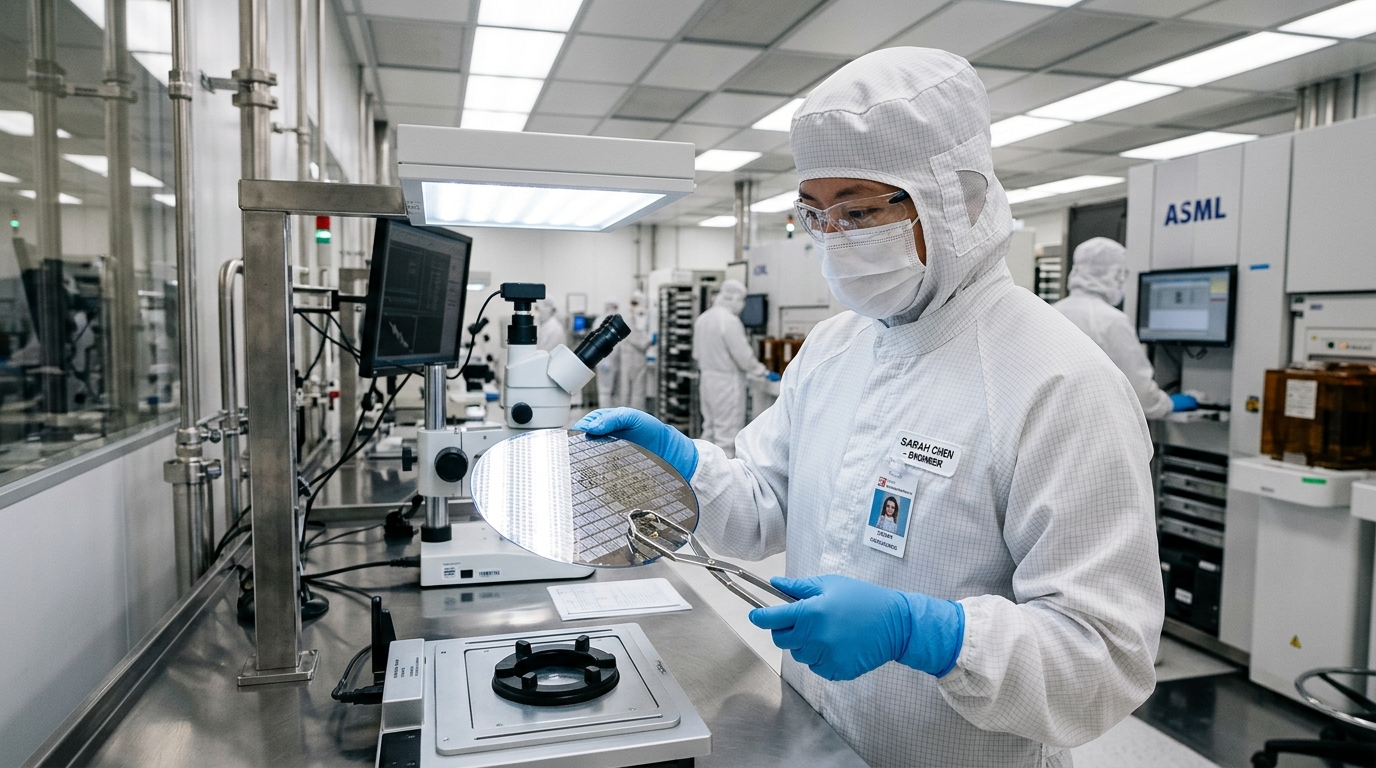 8.3B CoWoS Expansion, ASML High-NA Delays Push NVDA 2026 Q4 Revenue Down .5B, SK Hynix Margins Contract -7.2%" />
Key takeaways
- TSMC's CoWoS capacity is set to triple by late 2027, backed by an 8.3 billion CapEx, yet faces a critical 45% interposer wafer supply deficit, driving HBM3e contract prices up by 22%.
- ASML's High-NA EUV scanner deliveries are delayed until Q2 2027, impacting sub-2nm process roadmaps and potentially deferring over $50 billion in projected foundry CapEx for leading-edge nodes.
- NVIDIA faces a .5 billion revenue hit in Q4 2026 due to advanced packaging bottlenecks, while SK Hynix's operating margins for HBM products are projected to contract by 7.2% due to elevated interposer costs.
Market Dynamics & Earnings Data Breakdown
The semiconductor landscape continues its rapid evolution, driven by insatiable AI demand. Taiwan Semiconductor Manufacturing Company (TSM) has raised its Q3 2026 revenue guidance to an impressive 5.2 billion, representing a robust 12% year-over-year increase, primarily fueled by the accelerating adoption of its N3 and N5 advanced nodes, which now account for 58% of its total wafer revenue. This strong performance underpins TSMC's aggressive CoWoS (Chip-on-Wafer-on-Substrate) expansion plans, with capacity targeted to triple from approximately 120,000 to a staggering 360,000 12-inch equivalent wafers per month by the end of 2027. This ambitious ramp-up is supported by an estimated
8.3 billion in cumulative capital expenditures allocated specifically to advanced packaging facilities between 2024 and 2027.
NVIDIA (NVDA), a primary beneficiary of this AI-driven surge, projects its Q4 2026 AI segment revenue to reach 1.5 billion, a remarkable 150% increase year-over-year. However, the company has tacitly acknowledged a 15% fulfillment gap against hyperscaler demand, directly attributable to the bottlenecks in advanced packaging, particularly CoWoS. Competitor Advanced Micro Devices (AMD) is also ramping up its MI300X series, with analysts projecting it could capture 20% of new hyperscaler AI orders by 2027, potentially generating an additional $4.5 billion in revenue. The collective AI infrastructure capital expenditure from industry giants like Microsoft, Amazon AWS, and Google Cloud has surged by 35% in 2026, reaching an estimated
20 billion, signifying the depth of demand underpinning these market dynamics.
Meanwhile, ASML (ASML), the sole supplier of EUV lithography tools, reported a solid Q3 2026 revenue outlook of €7.1 billion, up 9% year-over-year. The firm has confirmed five orders for its cutting-edge High-NA EUV scanners, priced at approximately €350 million each, scheduled for delivery in 2027. Despite these orders, the initial deployment of High-NA EUV tools faces a revised timeline, which has significant implications for future sub-2nm process technologies and the broader semiconductor fabrication roadmap.
Supply Chain Bottlenecks & Macro Valuation Metrics
The robust demand for advanced packaging components has created critical chokepoints across the supply chain. The most acute shortage lies in interposer wafers, with a current supply shortfall estimated at 45% against escalating demand from leading-edge packaging houses. Key suppliers, including United Microelectronics Corporation (UMC) and Amkor Technology, are struggling to keep pace, leading to extended lead times now stretching between 18 and 24 months. This scarcity has a direct and severe impact on the production of High Bandwidth Memory (HBM) modules, particularly HBM3e, which are essential for AI accelerators.
The constrained interposer supply has driven HBM3e contract prices up sharply, with a 22% quarter-over-quarter increase projected for Q4 2026. This surge directly impacts memory manufacturers like SK Hynix, Samsung Electronics, and Micron Technology. SK Hynix, a market leader in HBM, is anticipating a 7.2% contraction in its HBM segment's operating margin due to the inflated costs of interposer wafers. This reflects a broader trend of cost pressures permeating the advanced memory market, even amidst soaring demand.
Further complicating the outlook is the revised timeline for ASML’s High-NA EUV tools, with the first customer deployment (reportedly Intel) now pushed from Q4 2026 to Q2 2027. This delay introduces uncertainty into the sub-2nm roadmap for leading foundries, potentially deferring over $50 billion in anticipated capital expenditures from the industry as fabs re-evaluate their investment cycles for future nodes. Current valuation multiples reflect some of these tensions: TSMC trades at a robust 28x Forward P/E, NVIDIA at 35x Forward P/E, and ASML at a premium 45x Forward P/E. The broader SOX Semiconductor Index has retreated 3.2% from its year-to-date peak of 8,100 points, now trading around 7,850, while the KOSPI index experienced a 1.8% intraday dip on recent news of exacerbated supply chain woes.
Quantitative Order Flow & Volatility Metrics
Quantitative analysis of options order flow reveals nuanced institutional sentiment amidst these supply chain pressures. For TSMC (TSM), significant bullish activity has been observed in out-of-the-money (OTM) call options. Specifically, the Jan 2027
90 strike calls traded over 30,000 contracts yesterday, representing 1.8 times their average daily volume, with a net buyers’ delta of +1.8 standard deviations. This indicates strong conviction among institutional players for further upside beyond current levels, despite the existing supply constraints.
NVIDIA (NVDA) options also exhibit a persistent bullish skew. The overall put-call ratio for Q4 2026 options stands at 0.78, significantly below its 52-week average of 0.95. This suggests that despite the acknowledged revenue guidance risks, market participants continue to position for long-term growth, with less hedging activity than typically seen in the face of such warnings. Implied volatility across the semiconductor sector has reacted to the heightened uncertainty; the SOX 3-month at-the-money (ATM) implied volatility has increased from 24.0% to 28.5% (+4.5 percentage points) over the past month, while NVDA’s 6-month ATM IV remains elevated at 42.0%.
Institutional capital flows indicate a strategic reallocation. Hedge funds, in particular, increased their net long positions in TSMC by approximately
.2 billion during Q3 2026, signaling a rotation towards foundational suppliers. Conversely, some funds have marginally trimmed their NVIDIA exposure by an estimated $600 million, potentially signaling near-term profit-taking or risk management around peak sentiment. Delta hedging activities related to these options positions contributed to an initial 0.3% dip in Nasdaq 100 futures following the release of the updated supply outlook, though the index quickly recovered much of those losses.
Quantitative Outlook
Key risks to this outlook include escalating geopolitical tensions, particularly regarding Taiwan, further unanticipated disruptions to critical supply chains (e.g., interposers, specialty chemicals), and a potential 10% deceleration in enterprise AI capital expenditures. Despite these risks, the overall semiconductor sector, as represented by the SOX Index, is projected to appreciate by another 15-20% over the next 12 months, potentially reaching the 9,000-9,400 range, primarily led by companies demonstrating leadership in advanced packaging and HBM technologies.
Tags: Memory Chips, SK Hynix, Semiconductors, Wall Street
The relentless demand for AI compute propels TSMC's CoWoS capacity to a staggering three-fold increase, but a critical 45% shortage in interposer wafer supply inflates HBM3e contract prices by 22% and threatens to shave Tradesnaut Quant Research Desk · September 16, 2026 · 6 min read · Semiconductors The semiconductor landscape continues its rapid evolution, driven by insatiable AI demand. Taiwan Semiconductor Manufacturing Company (TSM) has raised its Q3 2026 revenue guidance to an impressive 5.2 billion, representing a robust 12% year-over-year increase, primarily fueled by the accelerating adoption of its N3 and N5 advanced nodes, which now account for 58% of its total wafer revenue. This strong performance underpins TSMC's aggressive CoWoS (Chip-on-Wafer-on-Substrate) expansion plans, with capacity targeted to triple from approximately 120,000 to a staggering 360,000 12-inch equivalent wafers per month by the end of 2027. This ambitious ramp-up is supported by an estimated NVIDIA (NVDA), a primary beneficiary of this AI-driven surge, projects its Q4 2026 AI segment revenue to reach 1.5 billion, a remarkable 150% increase year-over-year. However, the company has tacitly acknowledged a 15% fulfillment gap against hyperscaler demand, directly attributable to the bottlenecks in advanced packaging, particularly CoWoS. Competitor Advanced Micro Devices (AMD) is also ramping up its MI300X series, with analysts projecting it could capture 20% of new hyperscaler AI orders by 2027, potentially generating an additional $4.5 billion in revenue. The collective AI infrastructure capital expenditure from industry giants like Microsoft, Amazon AWS, and Google Cloud has surged by 35% in 2026, reaching an estimated Meanwhile, ASML (ASML), the sole supplier of EUV lithography tools, reported a solid Q3 2026 revenue outlook of €7.1 billion, up 9% year-over-year. The firm has confirmed five orders for its cutting-edge High-NA EUV scanners, priced at approximately €350 million each, scheduled for delivery in 2027. Despite these orders, the initial deployment of High-NA EUV tools faces a revised timeline, which has significant implications for future sub-2nm process technologies and the broader semiconductor fabrication roadmap. The robust demand for advanced packaging components has created critical chokepoints across the supply chain. The most acute shortage lies in interposer wafers, with a current supply shortfall estimated at 45% against escalating demand from leading-edge packaging houses. Key suppliers, including United Microelectronics Corporation (UMC) and Amkor Technology, are struggling to keep pace, leading to extended lead times now stretching between 18 and 24 months. This scarcity has a direct and severe impact on the production of High Bandwidth Memory (HBM) modules, particularly HBM3e, which are essential for AI accelerators. The constrained interposer supply has driven HBM3e contract prices up sharply, with a 22% quarter-over-quarter increase projected for Q4 2026. This surge directly impacts memory manufacturers like SK Hynix, Samsung Electronics, and Micron Technology. SK Hynix, a market leader in HBM, is anticipating a 7.2% contraction in its HBM segment's operating margin due to the inflated costs of interposer wafers. This reflects a broader trend of cost pressures permeating the advanced memory market, even amidst soaring demand. Further complicating the outlook is the revised timeline for ASML’s High-NA EUV tools, with the first customer deployment (reportedly Intel) now pushed from Q4 2026 to Q2 2027. This delay introduces uncertainty into the sub-2nm roadmap for leading foundries, potentially deferring over $50 billion in anticipated capital expenditures from the industry as fabs re-evaluate their investment cycles for future nodes. Current valuation multiples reflect some of these tensions: TSMC trades at a robust 28x Forward P/E, NVIDIA at 35x Forward P/E, and ASML at a premium 45x Forward P/E. The broader SOX Semiconductor Index has retreated 3.2% from its year-to-date peak of 8,100 points, now trading around 7,850, while the KOSPI index experienced a 1.8% intraday dip on recent news of exacerbated supply chain woes. Quantitative analysis of options order flow reveals nuanced institutional sentiment amidst these supply chain pressures. For TSMC (TSM), significant bullish activity has been observed in out-of-the-money (OTM) call options. Specifically, the Jan 2027 NVIDIA (NVDA) options also exhibit a persistent bullish skew. The overall put-call ratio for Q4 2026 options stands at 0.78, significantly below its 52-week average of 0.95. This suggests that despite the acknowledged revenue guidance risks, market participants continue to position for long-term growth, with less hedging activity than typically seen in the face of such warnings. Implied volatility across the semiconductor sector has reacted to the heightened uncertainty; the SOX 3-month at-the-money (ATM) implied volatility has increased from 24.0% to 28.5% (+4.5 percentage points) over the past month, while NVDA’s 6-month ATM IV remains elevated at 42.0%. Institutional capital flows indicate a strategic reallocation. Hedge funds, in particular, increased their net long positions in TSMC by approximately Key risks to this outlook include escalating geopolitical tensions, particularly regarding Taiwan, further unanticipated disruptions to critical supply chains (e.g., interposers, specialty chemicals), and a potential 10% deceleration in enterprise AI capital expenditures. Despite these risks, the overall semiconductor sector, as represented by the SOX Index, is projected to appreciate by another 15-20% over the next 12 months, potentially reaching the 9,000-9,400 range, primarily led by companies demonstrating leadership in advanced packaging and HBM technologies. Tags: Memory Chips, SK Hynix, Semiconductors, Wall Street8.3B CoWoS Expansion, ASML High-NA Delays Push NVDA 2026 Q4 Revenue Down Key takeaways
Market Dynamics & Earnings Data Breakdown
Supply Chain Bottlenecks & Macro Valuation Metrics
Quantitative Order Flow & Volatility Metrics
Quantitative Outlook